
Employee quality,monitoring environment and internal control
2017-05-02 01:55:52ChunliLiuBinLinWeiShu
Chunli Liu,Bin Lin,Wei Shu,c
aSun Yat-sen Business School,Sun Yat-sen University,China
bEnterprise and NPO Internal Control Research Center,Sun Yat-sen University,China
cSchool of Business,Xi’an University of Finance and Economics,China
Employee quality,monitoring environment and internal control
Chunli Liua,b,*,Bin Lina,b,Wei Shua,b,c
aSun Yat-sen Business School,Sun Yat-sen University,China
bEnterprise and NPO Internal Control Research Center,Sun Yat-sen University,China
cSchool of Business,Xi’an University of Finance and Economics,China
A R TiClE I NfO
Article history:
Received 10 May 2016
Accepted 8 December 2016
Available online 16 January 2017
Employee
We investigate the effect of internal control employees(ICEs)on internal control quality.Using special survey data from Chinese listed firms,we find that ICE quality has a significant positive influence on internal control quality. We examine the effect of monitoring on this result and find that the effect is more pronounced for firms with strict monitoring environments,especially when the firms implement the Chinese internal control regulation system (CSOX),have higher institutional ownership or attach greater importance to internal control.Our findings suggest that ICEs play an important role in the design and implementation of internal control systems.Our study should be of interest to both top managers who wish to improve corporate internal control quality and regulators who wish to understand the mechanisms of internal control monitoring.
?2016 Sun Yat-sen University.Production and hosting by Elsevier B.V.This is an open access article under the CC BY-NC-ND license(http://creativecommons.org/licenses/by-nc-nd/4.0/).
1.Introduction
With the advent of the knowledge economy,human capital rather than physical assets has become the essential strategic resource of businesses.Rajan and Zingales(1998,2000)have formalized the human capital theory of corporate governance.They argue that governance problems are no longer concentrated at the top of a steep pyramid;the focus of corporate governance in the new millennium must shift to the governance problems of employees.However,previous studies provide limited evidence of the extent to which employees influence corporate actions.In this study,we focus on internal control because internal control is a core component of corporate activities and is thus suitable for assuring the achievement of objectives relating tooperations,reporting and compliance(COSO,2013).We contribute to the literature on internal control by examining the relationship between internal control employees(ICEs)and internal control quality,and the effect of monitoring on this relationship.
Specifically,we ask two complementary research questions.Our first question examines whether ICE quality influences internal control quality.We argue that high quality ICEs increase the human capital investments in the design and implementation of internal control process,and thus improve internal control quality.
Our second question examines whether the monitoring environment modifies the effect of ICE quality on internal control quality.Although we predict that ICE quality has a positive influence on internal control quality,it is possible that this influence may vary between firms that are stringently monitored and firms that are not stringently monitored by regulators,institutional investors and/or top managers.Stringent monitoring could alleviate the employee agency problem and provide ICEs with incentives not to shirk.The increased diligence of employees further promotes the positive effects of ICE quality.Therefore,we expect that the positive effect of ICE quality on internal control quality is more pronounced in firms that are subject to more stringent monitoring.
Using special survey data from Chinese listed firms,we study a sample of 1522 firm-year observations from the 2011 to 2013 period.We use number,education and job tenure as the quality attributes of ICEs,and find that high quality ICEs improve internal control quality.Further,we examine the effect of monitoring on this relationship,and find that the positive effect of ICE quality is more pronounced for firms in stringent monitoring environments.In particular,we find that the positive effect is more significant when firms implement the Chinese internal control regulation system(CSOX),have higher institutional ownership or attach greater importance to internal control.Our results are robust to the misreporting problem of internal control weaknesses,endogeneity bias and chairman turnover.
Our study contributes to two streams of research.Our first contribution was to the internal control literature.To the best of our knowledge,this is the first study to demonstrate the influence of ICEs on internal control quality.There is a large and growing literature examining the determinants of internal control quality (e.g.,Doyle et al.,2007;Ashbaugh-Skaife et al.,2007;Hoitash et al.,2009),but no study has examined the influence of ICEs.Given the increased importance of human capital in effective internal control(Doyle et al.,2007),we use special survey data from Chinese listed firms to examine how ICEs influence internal control quality.Our findings suggest that high quality ICEs are more likely to effectively discharge their responsibilities,thus increasing internal control quality.
Our second contribution was to the literature on the employee agency problem.To our knowledge,prior research has not examined the effect of monitoring mechanisms on the employee agency problem.We help fill this gap by providing the first evidence of the effect of monitoring on the relationship between ICEs and internal control quality.Our results suggest that monitoring by regulators,institutional investors and/or top managers could alleviate the employee agency problem and improve the positive effect of ICE quality.
The rest of this paper proceeds as follows.Section 2 introduces the institutional background and reviews related studies.Section 3 provides theoretical analysis and hypothesis development.Section 4 describes the research design,Sections 5 and 6 report the empirical results and robustness tests,respectively,and Section 7 concludes the paper.
2.Institutional background and literature review
2.1.Institutional background
In recent years,Chinese regulators have issued a series of internal control regulations.In May 2008,the five ministries,including the Ministry of Finance(MOF)and China Securities Regulatory Commission(CSRC), jointly issued the Basic Standards of Enterprise Internal Control(hereafter,the Basic Standards).In April 2010,the five ministries jointly issued a series of internal control guidelines,including the Implementation Guidelines for Enterprise Internal Control,the Guidelines for Assessment of Enterprise Internal Control and the Guidelines for Audit of Enterprise Internal Control.The Basic Standards and these guidelines constitute the internal control regulation system in China,which is also called CSOX.
Similar to the Sarbanes–Oxley Act in the United States,CSOX requires listed firms to carry out effective self-assessments of their internal control,to issue self-assessment reports on an annual basis and to appoint audit firms to audit internal control effectiveness and issue auditors’reports.Firms cross-listed on domestic and international exchanges have been required to adopt CSOX since 1 January 2011,and firms listed on the main boards of the Shanghai Stock Exchange(SSE)and Shenzhen Stock Exchange(SZSE)have been required to do so since 1 January 2012.
In February 2011,CSRC issued the Notice on the Assignments of Internal Control Pilots in Listed Firms and selected 216 listed firms as internal control pilots.The key pilot firms were required to adopt CSOX in 2011,and the other pilot firms have been required to do so since 2012.
In August 2012,MOF and CSRC jointly issued the Notice on Partial Implementation of Internal Control Regulation System by Main Board Listed Firms in 2012(hereafter,the Notice),which postponed the implementation date for firms listed on the main boards of the SSE and SZSE.The Notice required that:‘(1)Both central and local state owned listed firms should adopt CSOX in 2012 and disclose their annual selfassessments and auditors’reports on internal control along with their 2012 annual reports;(2)Non-state owned main board firms whose market values are larger than 5 billion RMB on 31 December 2011 and average net profits between 2009 and 2011 are larger than 30 million RMB,should disclose their annual selfassessments and auditors’reports on internal control along with their 2013 annual reports;(3)Other main board firms should disclose their annual self-assessments and auditors’reports on internal control along with their 2014 annual reports.”MOF and CSRC do not require the firms listed on the Small and Medium-size Enterprise Board or the ChiNext market to implement CSOX.
2.2.Literature review
Our study is related to the following two research areas:(1)determinants of internal control quality;and(2) the employee agency problem.
2.2.1.Determinants of internal control quality
Previous studies have examined the determinants of internal control quality along the following three dimensions.First,from the perspective of corporate characteristics,many studies have investigated the effects of the complexity and scope of operations,organizational change,internal control resources and accounting application risk on internal control weaknesses(e.g.,Doyle et al.,2007;Ashbaugh-Skaife et al.,2007;Lin and Rao,2009;Tian et al.,2010;Rice and Weber,2012).They all find that relative to non-disclosers,firms that disclose internal control weaknesses have more complex operations,recent organizational changes,greater accounting risk and fewer resources available for internal control.
Second,from the perspective of top management’s characteristics,Li et al.(2010)examine the effect of CFOs’professional qualifications on internal control weaknesses and prove that firms that disclose internal control weaknesses have less-qualified CFOs.
Third,from the perspective of governance mechanisms,Krishnan(2005),Naiker and Sharma(2009)and Hoitash et al.(2009)analyze the effects of audit committee characteristics on internal control weaknesses and find that independent audit committees and audit committees with financial expertise are significantly less likely to be associated with incidences of internal control weaknesses.Masli et al.(2010)document that the implementation of internal control monitoring technology is associated with the lower likelihood of internal control material weaknesses.Lin et al.(2011)examine the relationship between material weakness disclosures and internal audit function and observe that material weakness disclosures are negatively associated with internal audit quality.Gong et al.(2013)argue that for cross-listed firms domiciled in weak investor protection countries,firms whose managers control their firms and have voting rights in excess of cashflow rights are more likely to misreport internal control weaknesses than other firms.Balsam et al.(2014)examine the relation between executive equity incentives and material weaknesses and prove that the likelihood of material weakness disclosures decreases with increases in equity incentives.Last but not the least,Guo et al.(2016)provide empirical evidence that personnel-friendly practices significantly attenuate internal control ineffectiveness.
In summary,although previous studies have examined the determinants of internal control from different perspectives,no study has investigated the influence of employees.Recognizing the increased importance ofhuman capital in effective internal control,we focus on ICEs and examine the effect of ICEs on internal control quality.
2.2.2.Employee agency problem
Prior studies have provided evidence that employees play an important role in corporate activities.For example,Edmans(2011)analyzes the relationship between employee satisfaction and long-term stock returns, and proves that employee satisfaction is positively correlated with shareholder returns.Bae et al.(2011)investigate corporate capital structure from the perspective of a firm’s relations with its employees,and find that firms that treat their employees fairly maintain low debt ratios.Wu and Liu(2009)examine the effect of employee quality on R&D activities using special survey data from private firms in China,and document that employee quality has a signi ficantly positive effect on R&D activities.Huang and Li(2014)investigate the relationship between employees and investment using special data from manufacturing firms in China,and find that the number of employees is positively associated with over-investment when firms face unfavorable investment opportunities.
However,the existence of the employee agency problem attenuates the positive effects of employees.Previous studies have examined how to alleviate the employee agency problem through motivation mechanisms such as compensation,stock options and ownership.For example,Chen et al.(2015)argue that employee compensation incentives have a signi ficantly positive effect on earnings growth.Chang et al.(2015)provide empirical evidence of the positive effect of non-executive employee stock options on corporate innovation. Bova et al.(2015a,2015b)document that employee ownership is positively associated with voluntary disclosure and negatively associated with risk.Kim and Ouimet(2014) find that small employee stock ownership plans increase corporate productivity,but the effect is weaker when there are too many employees to mitigate free-riding.
To the best of our knowledge,there is no research examining the effect of monitoring on the employee agency problem.Hence,we focus on ICEs and investigate the effect of monitoring on the relationship between ICEs and internal control quality,which helps to fill the gap in the literature on the employee agency problem.
3.Theoretical analysis and hypothesis development
We develop our research questions on the basis of the input-process-output theory and agency theory. First,Gladstein(1984)has formalized the input-process-output theory of group effectiveness,and highlights that group composition,such as employee quality,has a critical effect on group effectiveness.Therefore,our first research question is,in terms of ICE teams,does ICE quality in fluence internal control quality?
Second,according to agency theory,the preference for leisure induces employees to reduce their productive effort,thus leading to the agency con flict between top managers and employees(Alchian and Demsetz,1972). A remedy to this problem is to invest resources into monitoring employees(Holmstrom,1979).Therefore,our second research question is,in terms of internal control activities,does stringent monitoring promote the positive effect of ICE quality on internal control quality by improving ICE work efficiency?
Our theoretical framework is presented in Fig.1.Based on this framework,we develop our hypotheses.
3.1.ICE quality and internal control quality
In his formalization of the input-process-output theory,Gladstein(1984)emphasizes that team composition,team structure,resources available and organizational structure are the four major determinants of team effectiveness.As a part of team composition,employee qualities such as the number,education degree and job tenure of employees assume enormous importance.Based on the input-process-output theory,we focus on ICE teams and argue that ICE quality could influence internal control effectiveness both directly and indirectly,as shown in Fig.1.On the one hand,Ge and McVay(2005)indicate that a shortage of qualified staffis a common cause of internal control ineffectiveness.So high quality ICEs are more likely to discharge their responsibilities to adequately design and implement internal control policies and procedures,which directly increase internal control quality.

Figure 1.Theoretical framework.
On the other hand,ICE quality indirectly influences internal control quality through work processes.Take job tenure as an example:ICEs with long job tenure are more familiar with corporate culture and internal communication styles,and this improves the efficiency of the communication process(Zenger and Lawrence,1989).Moreover,communication efficiency is crucial to internal control quality because the essential components of internal control work include communicating with top managers to establish and improve the internal control system,communicating with employees to monitor regular control activities and communicating with internal and external auditors to provide audit assistance.Hence,ICEs with long job tenures could indirectly increase internal control quality by improving communication efficiency.
Based on the above discussion,we use the number,education and job tenure of ICEs as proxies for ICE quality,and specify our first hypothesis as follows.
H1.ICE quality has a positive in fluence on internal control quality.
Agency problems exist not only between shareholders and top managers,but also between top managers and employees(Weber,1947;Holmstrom and Milgrom,1994).Employees usually prefer leisure and have an incentive to shirk(Jensen and Meckling,1976),which attenuates the positive effect of employee quality. Could monitoring alleviate the employee agency problem and improve the positive effect of ICE quality on internal control quality?To address this research question,we examine the influence of three different monitoring mechanisms(i.e.,implementation of CSOX,institutional investors and managerial attention)on the relationship between ICE quality and internal control quality.
3.2.Implementation of CSOX
The internal control self-assessment reports voluntarily disclosed by listed firms before the implementation of CSOX are devoid of substance(Tian et al.,2010),as it is difficult for regulators to carry out effectivemonitoring of internal control without clear guidelines.The relaxed monitoring in the pre-CSOX period increases the possibility of ICE shirking and reduces the positive effect of ICE quality on internal control quality.
In contrast,since the implementation of CSOX listed firms is required to issue self-assessment and audit reports on internal control in accordance with CSOX guidelines,such monitoring improves the positive effect of ICE quality through the following two channels.First,the implementation of CSOX increases the workload of ICEs.The detailed requirements in CSOX reduce the arbitrariness of internal control self-assessment,forcing ICEs to work harder and alleviating the employee agency problem.For example,according to CSOX requirements,ICEs should‘obtain sufficient appropriate evidence to be able to assess the effectiveness of design and implementation of internal control through a variety of approaches,including inquiry,survey,discussion,walk through testing, field inspection,sampling and comparative analysis.”
Second,the implementation of CSOX strengthens the external monitoring of internal control.CSOX provides clear guidelines for regulators and external auditors and improves their ability to monitor internal control.The enhanced external monitoring reduces the possibility of ICE shirking and improves the positive effect of ICE quality on internal control quality.Based on the preceding arguments,we propose the following hypothesis.
H2.The positive effect of ICE quality on internal control quality is more pronounced in the post-CSOX period.
3.3.Monitoring of institutional investors
Previous studies have shown that institutional investors in fluence corporate governance in two ways.First, by voting with their feet:Institutional investors can indirectly express their attitudes by buying or selling stocks.Second,by voting with their hands:Institutional investors can serve as active monitors and in fluence corporate governance through their voting rights.Institutional investors with large equity positions have greater incentives to play a monitoring role,because the bene fits they receive from their monitoring activities are more likely to exceed the costs of monitoring(Shleifer and Vishny,1986).Moreover,large ownership positions allow institutional investors to exert greater in fluence on corporate governance,which further motivates them to serve as active monitors rather than free-riders.
As internal control is essential for corporate governance,institutional investors have an incentive to monitor internal control quality,especially when they have large ownership positions.The monitoring of institutional investors prevents ICEs from shirking and increases the positive effect of ICE quality on internal control quality.This leads to our third hypothesis.
H3.The positive effect of ICE quality on internal control quality is more pronounced among firms with higher institutional ownership.
3.4.Managerial attention to internal control
The tone set by top management is fundamental to the functioning of an internal control system(COSO, 2013).High managerial attention to internal control could alleviate the agency problem between top managers and employees.Speci fically,when top managers attach great importance to internal control,they will devote more effort to ICE monitoring,which reduces the possibility of ICE shirking and increases the positive effect of ICE quality.In contrast,when top managers pay little attention to internal control and ICE monitoring, ICEs will be inclined to take more leisure,which further reduces the positive effect of ICE quality.Based on the preceding arguments,we propose the following hypothesis.
H4.The positive effect of ICE quality on internal control quality is more pronounced when top managers attach greater importance to internal control.
4.Research design
4.1.Data and sample selection
Our data for ICE quality and managerial attention come from the 2014 Internal Control Survey of Chinese Listed Firms.This questionnaire survey was conducted by the Research Group of Internal Control to examine the internal control status of Chinese listed firms.The questionnaires were distributed to all 2536 listed firms on 5 September 2014 and collected on 31 October 2014,with a recovery rate of 84.94%.In early November 2014,the Research Group of Internal Control randomly chose 12 respondents for field investigation to confirm the validity of the survey responses.
This survey provides ICE quality data for the 2011 to 2013 period,including the number,education and job tenure of ICEs.As stated in the questionnaire,ICEs include the employees who are commonly responsible for the establishment and regular monitoring of internal control,but exclude employees in the internal audit department,the internal control manager and other top managers.
The survey also provides information about managerial attention.Speci fically,chairmen are required to answer the following question:In your opinion,to what extent does your firm demand internal control?A. Not at all;B.A little;C.Fair;D.Much;E.Very much.
Our sample starts with all of the Chinese non- financial firms with effective ICE data for the 2011 to 2013 period.First,we remove the firms listed on the Small-and Medium-sized Enterprise board and the ChiNext market,because these firms are not required to implement CSOX and their internal control regulations are systematically different from those of firms listed on the main boards.Next,we merge the remaining observations with the DIB internal control database,CSMAR database and WIND database. Finally,we drop observations with missing variable information.Our final sample contains 1522 firmyear observations.
4.2.Model specification and variable description
4.2.1.Models of H1
To test the effect of ICE quality on internal control quality,we estimate the following models,drawn from previous studies(e.g.,Doyle et al.,2007;Ashbaugh-Skaife et al.,2007):
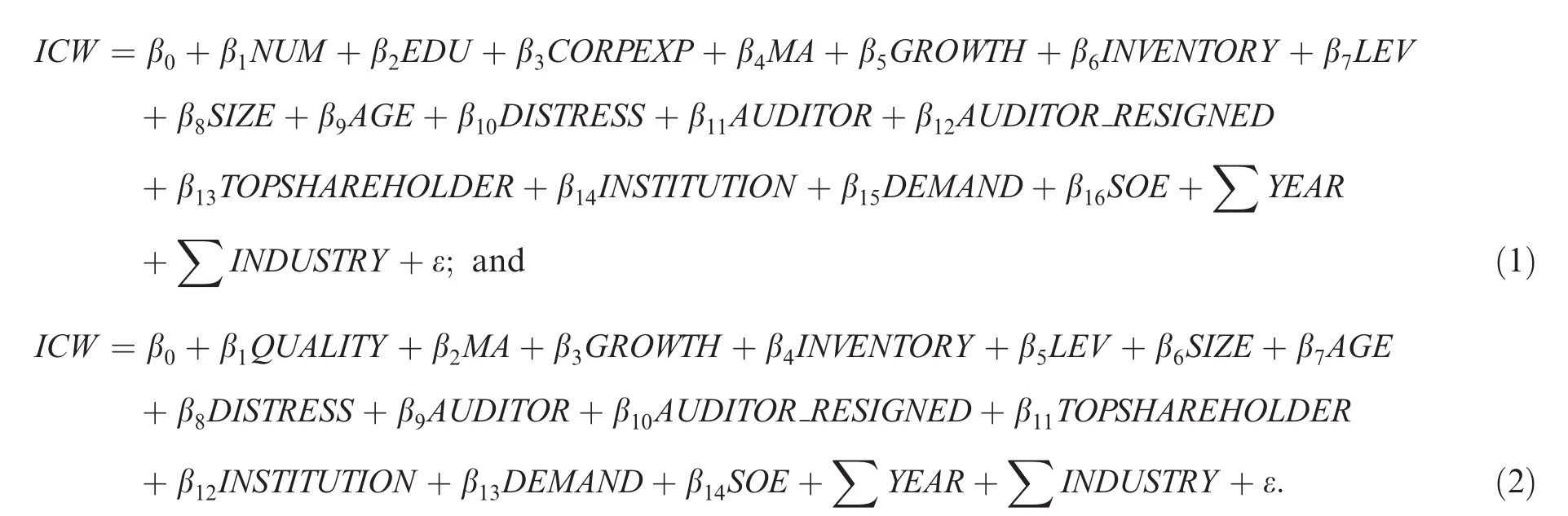
ICWis an indicator variable that is coded 1 if the firm discloses at least one internal control weakness in the given fiscal year,and 0 otherwise.We useICWas the dependent variable to measure internal control quality; the disclosure of internal control weaknesses means low internal control quality.
With respect to explanatory variables,we use number(NUM),education(EDU)and job tenure(CORPEXP)to measure ICE quality in model 1.Specifically,NUMequals the fiscal year-end number of ICEs deflated by the total number of employees times 100.EDUequals the fiscal year-end number of ICEs with a bachelor degree or above deflated by the total number of ICEs.CORPEXPequals the fiscal year-end number of ICEs who have worked in the firm no less than 5 years deflated by the total number of ICEs.
We construct a comprehensive ICE quality measure (QUALITY)in model 2.Specifically,QUALITY=NUM_dummy+EDU_dummy+CORPEXP_dummy,whereNUM_dummy,EDU_dummyorCORPEXP_dummyare indicator variables that are coded 1 if the value forNUM,EDUorCORPEXPis larger than the mean of the sample in the same fiscal year and industry,and 0 otherwise.
With respect to control variables,Doyle et al.(2007)and Ashbaugh-Skaife et al.(2007)find that the complexity and scope of operations,internal control resources and governance mechanisms influence internal control quality.Accordingly,we include M&A activities(MA),percentage change of sales(GROWTH), percentage of inventory(INVENTORY)and leverage ratio(LEV)to control for the effects of the complexity and scope of operations.We also include firm size(SIZE),listed years(AGE)and the severity of financial distress(DISTRESS)to control for the effects of internal control resources.We add the use of a Big 4 audit firm (AUDITOR),change of auditors(AUDITOR_RESIGNED),largest shareholder ownership(TOPSHAREHOLDER)and institutional ownership(INSTITUTION)to capture the effects of governance mechanisms. In addition,we control for chairman’s attention to internal control(DEMAND),state-owned firms(SOE), year dummy variables and industry dummy variables.Detailed definitions of each variable are given in Table 1.
4.2.2.Models of H2
To test H2,we construct four interaction terms and estimate the following models:
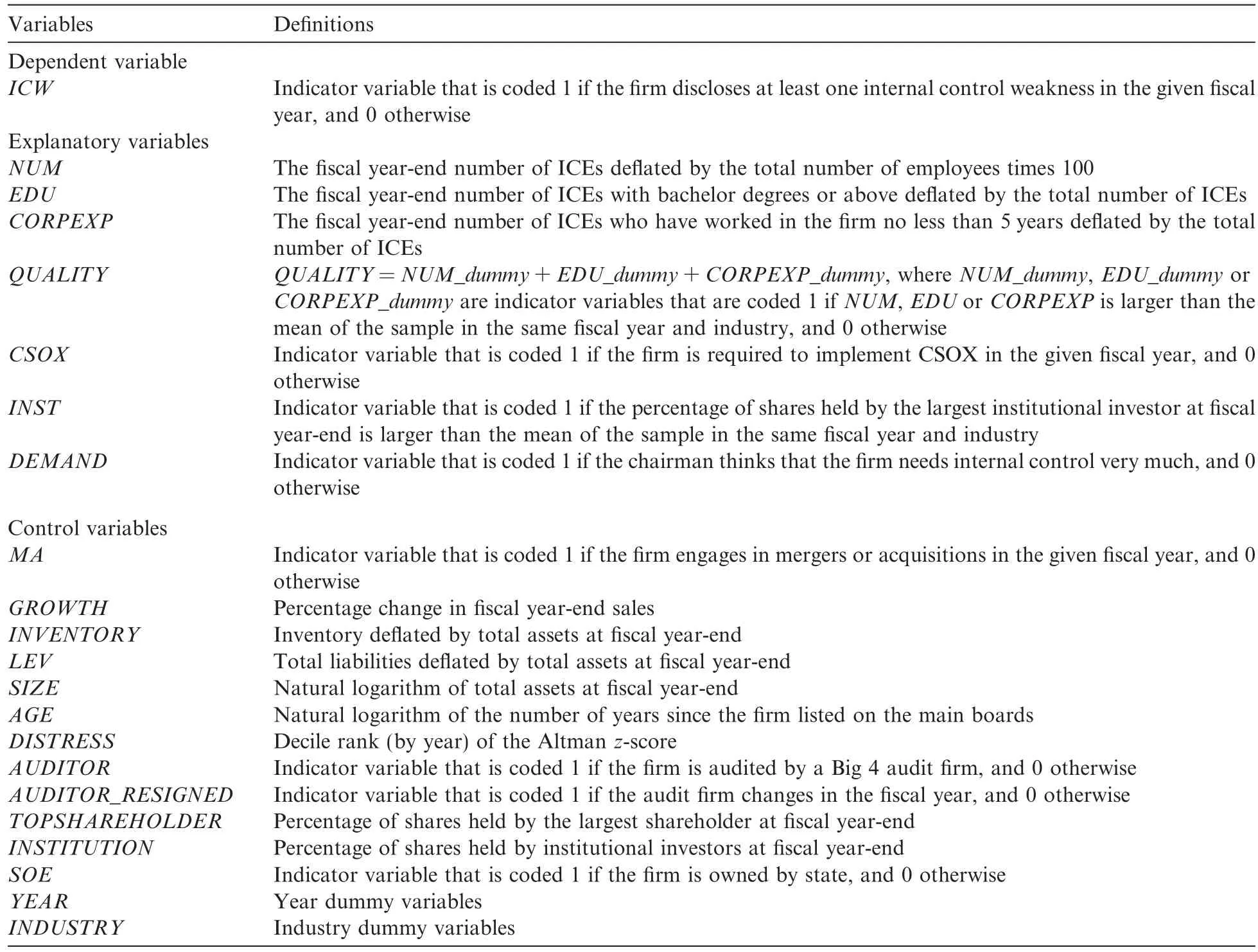
Table 1 Summary of variables.
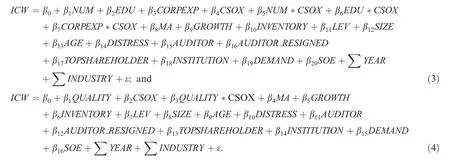
CSOXis an indicator variable that is coded 1 if the firm is required to implement CSOX in the given fiscal year,and 0 otherwise.Specifically,variableCSOXis coded 1 only for the following observations:(1)crosslisted firms and key pilot firms in the 2011 to 2013 period;(2)state owned listed firms and other pilot firms from the 2012 to 2013 period;and(3)non-state owned main board firms in 2013 whose market values are larger than 5 billion RMB on 31 December 2011 and whose average net profits in the 2009 to 2011 period are larger than 30 million RMB.
We multiplyCSOXbyNUM,EDU,CORPEXPandQUALITYto construct interaction terms(NUM*CSOX,EDU*CSOX,CORPEXP*CSOXandQUALITY*CSOX),and investigate whether the implementation of CSOX influences the positive effect of ICE quality.The other variables in models 3 and 4 are similar to those in models 1 and 2.Detailed definitions of all of the variables are given in Table 1.
4.2.3.Models of H3
To test H3,we construct four interaction terms and estimate the following models:
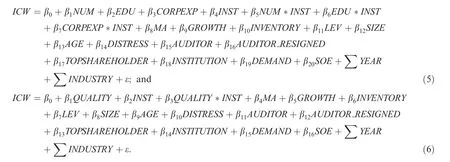
INSTis an indicator variable that is coded 1 if the percentage of shares held by the largest institutional investor at fiscal year-end is larger than the mean of the sample in the same fiscal year and industry.It is worth noting that we only focus on the largest institutional investors,as they are most likely to serve as active monitors(Shleifer and Vishny,1986).We multiplyINSTbyNUM,EDU,CORPEXPandQUALITYto construct interaction terms(NUM*INST,EDU*INST,CORPEXP*INSTandQUALITY*INST),and investigate whether the monitoring of institutional investors influences the positive effect of ICE quality.The other variables in models 5 and 6 are similar to those in models 1 and 2.Detailed definitions of all of the variables are given in Table 1.
4.2.4.Models of H4
To test H4,we construct four interaction terms and estimate the following models:

We use the attitude of each company’s chairman toward internal control as a proxy for managerial attention,and assume that a chairman’s attitude remains unchanged throughout the 2011 to 2013 period.DEMANDis an indicator variable that is coded 1 if the chairman thinks that the firm needs internal control very much,and 0 otherwise.We multiplyDEMANDbyNUM,EDU,CORPEXPandQUALITYto construct interaction terms(NUM*DEMAND,EDU*DEMAND,CORPEXP*DEMANDandQUALITY*DEMAND),and investigate whether managerial attention to internal control influences the positive effect of ICE quality.The other variables in models 7 and 8 are similar to those in models 1 and 2.Detailed definitions of all of the variables are given in Table 1.
4.3.Descriptive statistics
Table 2 presents the descriptive statistics for all of the variables.We winsorize all of the continuous variables at the 0.01 and 0.99 levels.In Table 2,the mean ofICWis 0.214,which indicates that 21.4%of the observations disclose internal control weaknesses.The mean ofNUMis 0.616,indicating that on average,ICEs make up about 0.6%of the total number of employees.The mean ofEDUis 0.792,indicating that 79.2%of ICEs have bachelor or higher degrees.The mean ofCORPEXPis 0.590,indicating that 59%of ICEs have worked at the same firm for no less than 5 years.
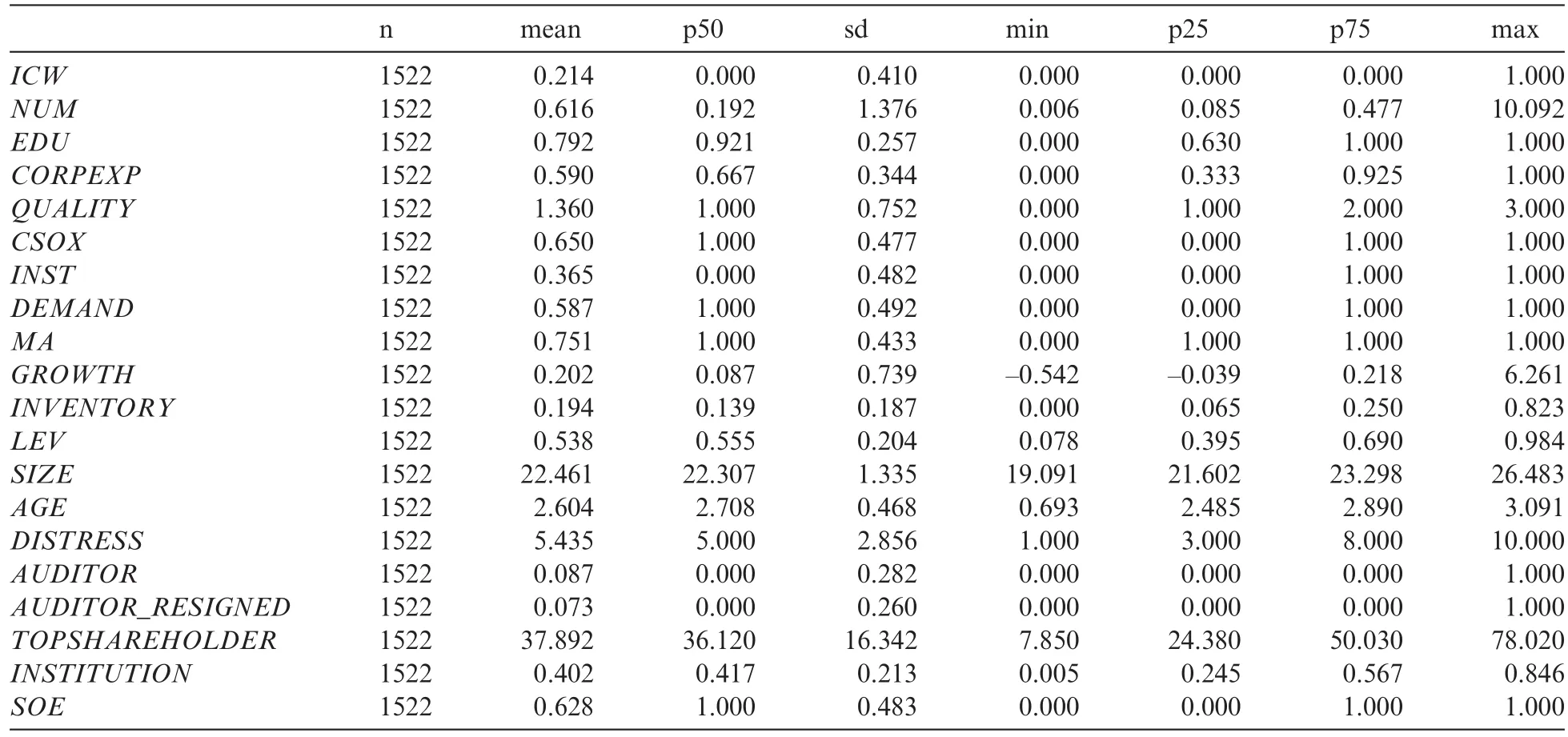
Table 2 Descriptive statistics.
5.Empirical results
5.1.Multivariate analysis of H1
We use models 1 and 2 to test whether ICE quality significantly influences internal control quality.All of the significance tests in our study are two-tailed tests.Multicollinearity tests show that the means of the variance inflation factors in models 1 and 2 are 1.44 and 1.45,respectively,indicating that there are no multicollinearity problems in our empirical models.
The regression results are shown in Table 3.Our explanatory variables of interest,the coefficients ofNUM,EDUandQUALITY,are significantly negative.These results provide support for H1 by suggesting that high ICE quality increases the human capital investments in the design and implementation of internal control processes,thus increasing internal control quality.The results of the control variables in Table 3 are consistent with previous studies.
5.2.Multivariate analysis of H2
We examine whether the implementation of CSOX influences the effect of ICE quality on internal control quality.As explained above,the implementation of CSOX not only imposes detailed requirements on internal control work,but also strengthens the monitoring of regulators and external auditors.Enhanced external monitoring reduces the possibility of ICE shirking and improves the positive effect of ICE quality.Hence, we expect that the positive effect of ICE quality on internal control quality is more pronounced after the implementation of CSOX.
To test this conjecture,we conduct two tests.The results are given in Table 4.First,we re-estimate models 1 and 2 separately on a sample of firms that have not implemented CSOX(the‘PRE”sample,i.e.,CSOX=0) and on a sample of firms that have implemented CSOX(the‘POST”sample,i.e.,CSOX=1).The results are reported in columns(1),(2),(4)and(5)of Table 4.Consistent with our expectation,we find thatNUM,EDU,CORPEXPandQUALITYhave no significant effect on internal control weaknesses in the pre-CSOX sample. In contrast,the coefficients ofNUM,EDUandQUALITYare negative and significant at the 0.01 level in the post-CSOX sample.
Second,we add the interaction terms and perform the full sample regressions using models 3 and 4.As shown in columns(3)and(6)of Table 4,the coefficients ofNUM*CSOX,EDU*CSOXandQUALITY*CSOXare significantly negative.These results suggest that the implementation of CSOX alleviates the employee agency problem and improves the positive effect of ICE quality,thereby supporting H2.
5.3.Multivariate analysis of H3
We examine whether institutional ownership in fluences the effect of ICE quality on internal control quality. As explained above,large ownership positions motivate institutional investors to play an active role in ICE monitoring,thus reducing the possibility of ICE shirking and improving the positive effect of ICE quality. Hence,we expect that the positive effect of ICE quality on internal control quality is more pronounced among firms with higher institutional ownership.
To test this conjecture,we conduct two tests.The results are given in Table 5.First,we re-estimate models 1 and 2 separately on a sample of firms with lower institutional ownership(the‘LOW”sample,i.e.,INST=0) and another sample of firms with higher institutional ownership(the‘HIGH”sample,i.e.,INST=1).The results are reported in columns(1),(2),(4)and(5)of Table 5.Consistent with our expectation,only the coefficient ofNUMis signi ficantly negative when institutional ownership is relatively low.In contrast,all of the coefficients ofNUM,EDUandQUALITYare negative and signi ficant at the 0.01 level when institutional ownership is relatively high.
Second,we add the interaction terms and perform the full sample regressions according to models 5 and 6. As shown in columns(3)and(6)of Table 5,the coefficients ofNUM*INST,EDU*INSTandQUALITY*INSTare significantly negative.These results suggest that high institutional ownership alleviates the employee agency problem and improves the positive effect of ICE quality,thereby supporting H3.
5.4.Multivariate analysis of H4
We also examine whether managerial attention to internal control influences the effect of ICE quality on internal control quality.As explained above,when top managers attach great importance to internal control,
they devote more effort to ICE monitoring,which reduces the possibility of ICE shirking and increases the positive effect of ICE quality.Hence,we expect that the positive effect of ICE quality on internal control quality is more pronounced when top managers attach great importance to internal control.
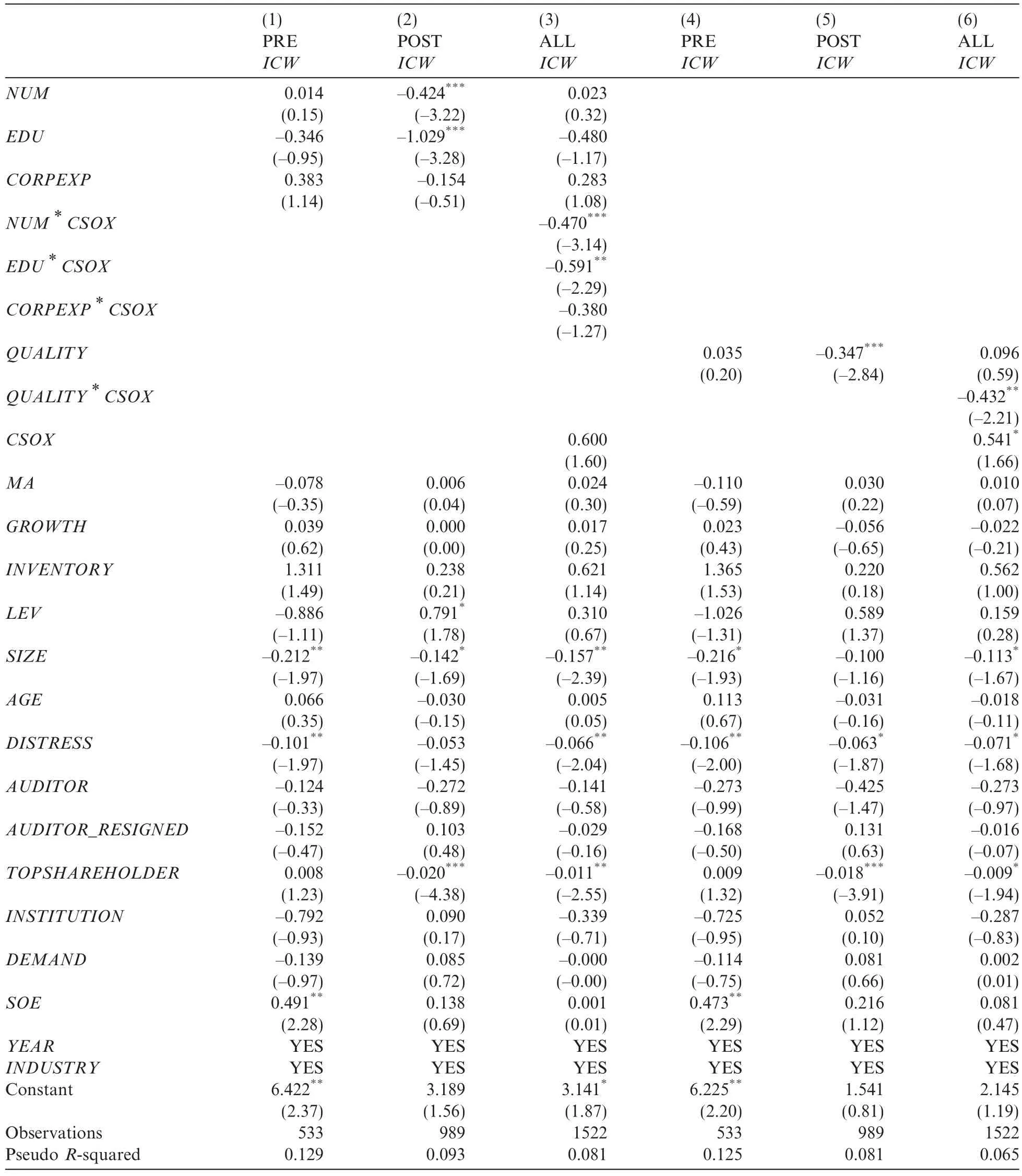
Table 4 Implementation of CSOX.
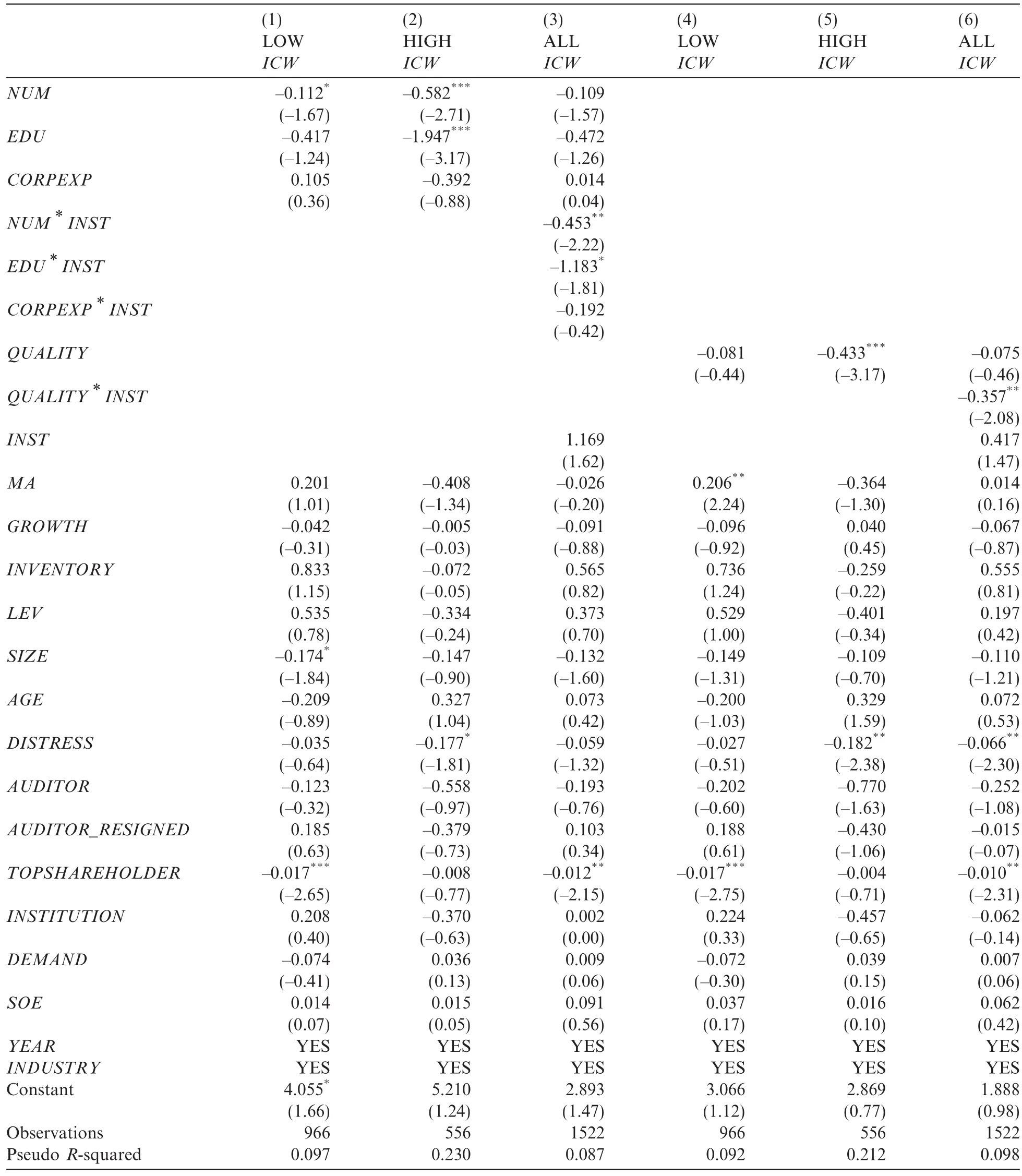
Table 5 Monitoring of institutional investors.
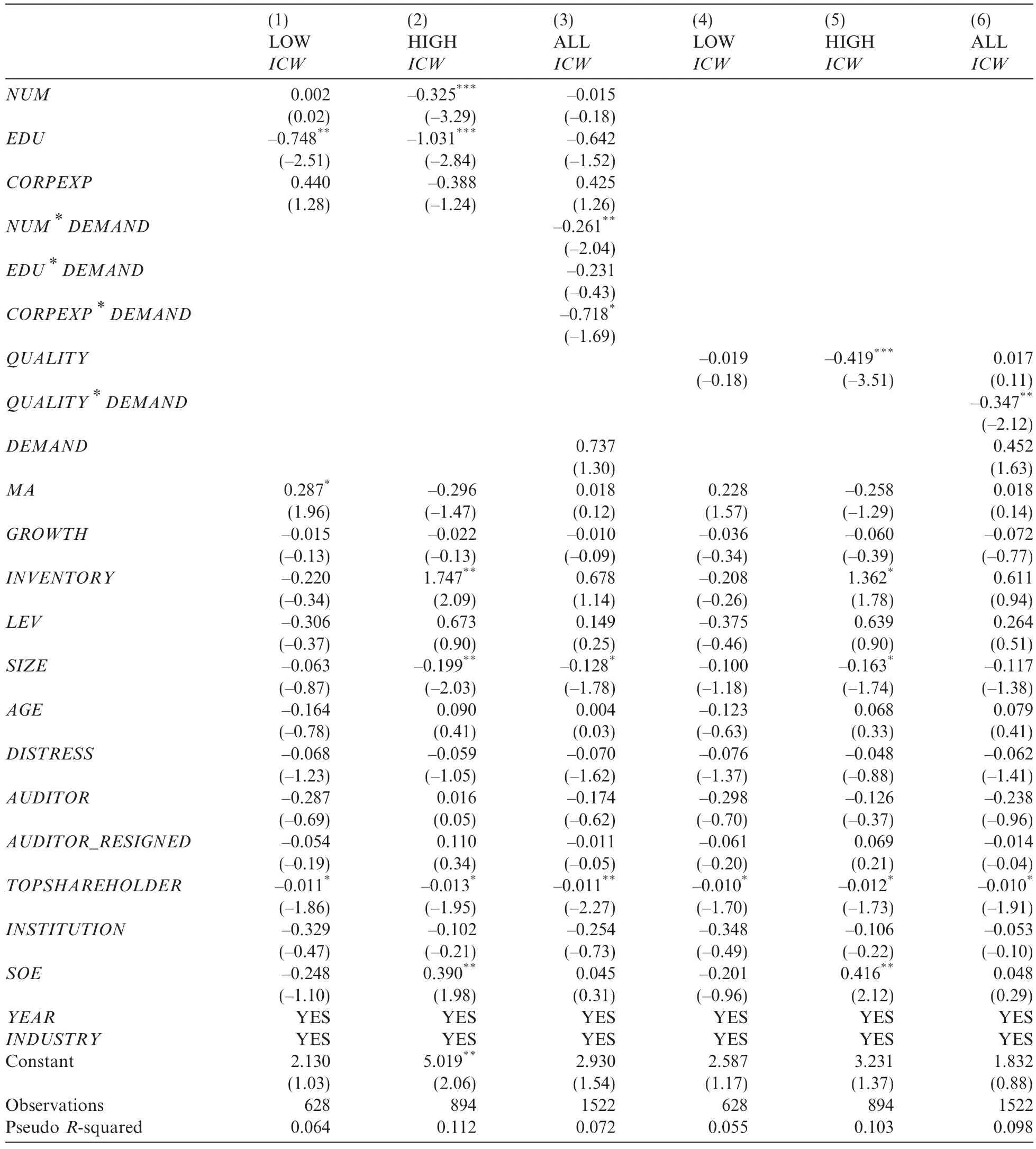
Table 6 Managerial attention to internal control.
To test this conjecture,we conduct two tests.The results are given in Table 6.First,we re-estimate models 1 and 2 separately on a sample of firms with less managerial attention to internal control(the‘LOW”sample, i.e.,DEMAND=0)and a sample of firms with more managerial attention to internal control(the‘HIGH”sample,i.e.,DEMAND=1).The results are reported in columns(1),(2),(4)and(5)of Table 6.Consistent with our expectation,only the coefficient ofEDUis significantly negative when top managers pay less attention to internal control.In contrast,all of the coefficients ofNUM,EDUandQUALITYare negative and significant at the 0.01 level when top managers pay more attention to internal control.
Second,we add the interaction terms and perform the full sample regressions according to models 7 and 8. As shown in columns(3)and(6)of Table 6,the coefficients ofNUM*DEMAND,CORPEXP*DEMANDandQUALITY*DEMANDare significantly negative.These results suggest that high managerial attention alleviates the employee agency problem and improves the positive effect of ICE quality,thereby supporting H4.
6.Robustness tests
6.1.Alternative measure of internal control quality
Firms have an incentive to conceal internal control weaknesses,especially when they are domiciled in weak investor protection countries(Gong et al.,2013).Hence,to alleviate the influence of internal control weakness misreporting and ensure the validity of our results,we re-estimate our models usingICW1as an alternative measure of internal control quality.Specifically,following PCAOB Auditing Standard No.5,we assume that the firms with operational irregularities or modified audit opinions have internal control weaknesses no matterwhether they make disclosures.ICW1is an indicator variable that is coded 1 if the firm discloses at least one internal control weakness,is punished for operational irregularities or receives a modified audit opinion in the given fiscal year,and 0 otherwise.
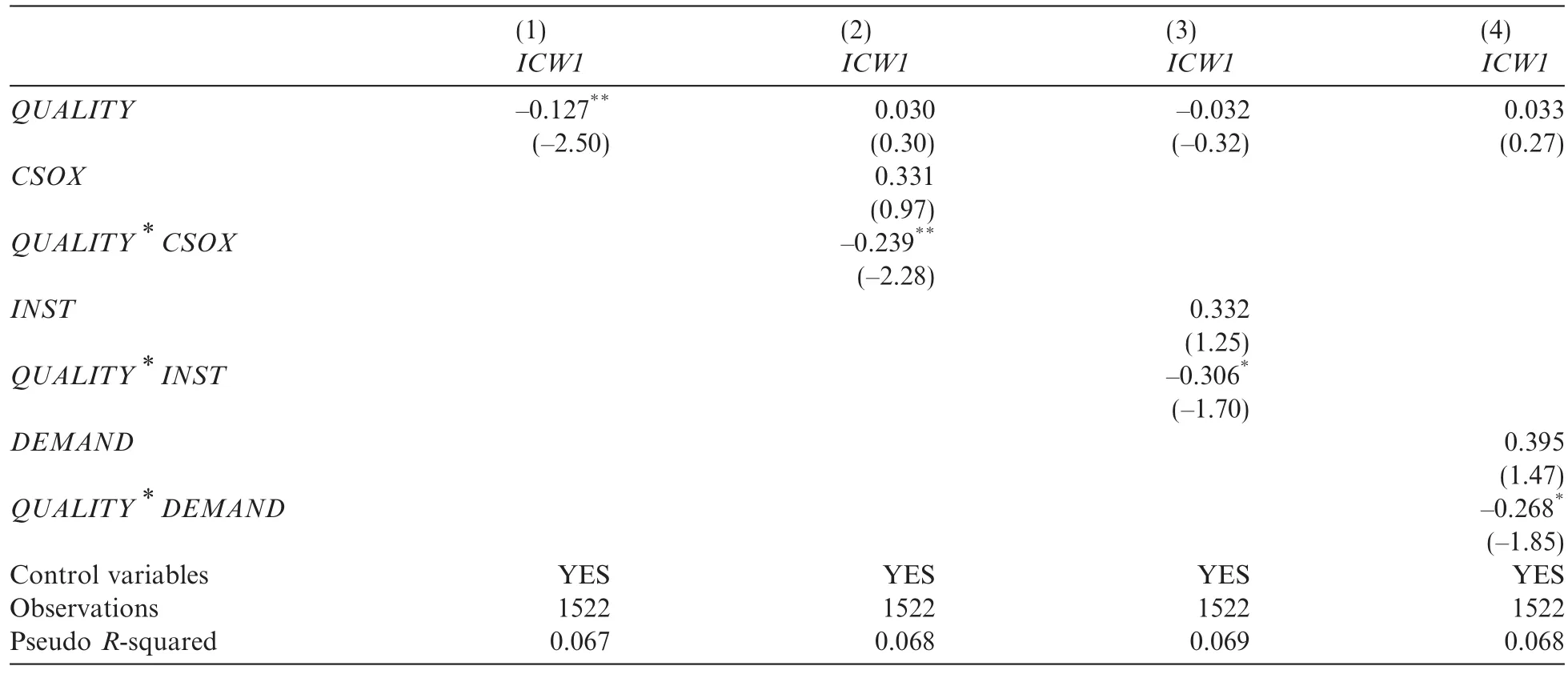
Table 7 Alternative measure of internal control quality.
The regression results are shown in Table 7.For the sake of brevity,we only report the results of the main variables.We find that the coefficients ofQUALITY,QUALITY*CSOX,QUALITY*INSTandQUALITY*DEMANDare significantly negative.These findings furnish additional support for all of our hypotheses.That is,ICE quality has a significant positive influence on internal control quality,and the positive effect is more pronounced for the firms in the strict monitoring environment,specifically for firms that have implemented CSOX,have higher institutional ownership,or attach great importance to internal control.
6.2.Endogeneity issue
Internal control quality influences the allocation efficiency of human capital,which,in turn,influences ICE quality.This reverse causality could induce an endogenous problem in our research.Therefore,we use a twostage least squares(2SLS)regression method,adopting two instruments to alleviate the effect of endogeneity. In this subsection,we first introduce the instrumental variables constructed to capture ICE quality.
The provincial supply of internal control human resources is exogenous to the ICE quality of local firms but has no direct economic effect on firms’internal control quality(i.e.,it is uncorrelated with the error term of the regression relating to firms’internal control quality).Thus,we choose the following two provincial variables as instruments to measure the human resource supply in the province where the firm is located:percentage of college graduates among the residents of the province(BACHELOR)and the per-capita gross domestic product of the province(GDP).In other words,it is easier for firms to hire qualified ICEs when they are located in provinces with a more highly educated population.Hence,we expect thatBACHELORis positivelyrelated to firms’ICE quality.Furthermore,higher per-capita gross domestic product also helps provinces to attract talented persons and therefore increases the provincial supply of internal control professionals.Therefore,we expect thatGDPis to be positively related to firms’ICE quality.The data forBACHELORandGDPare from the Chinese labor statistical yearbooks and the Chinese statistical yearbooks,respectively.
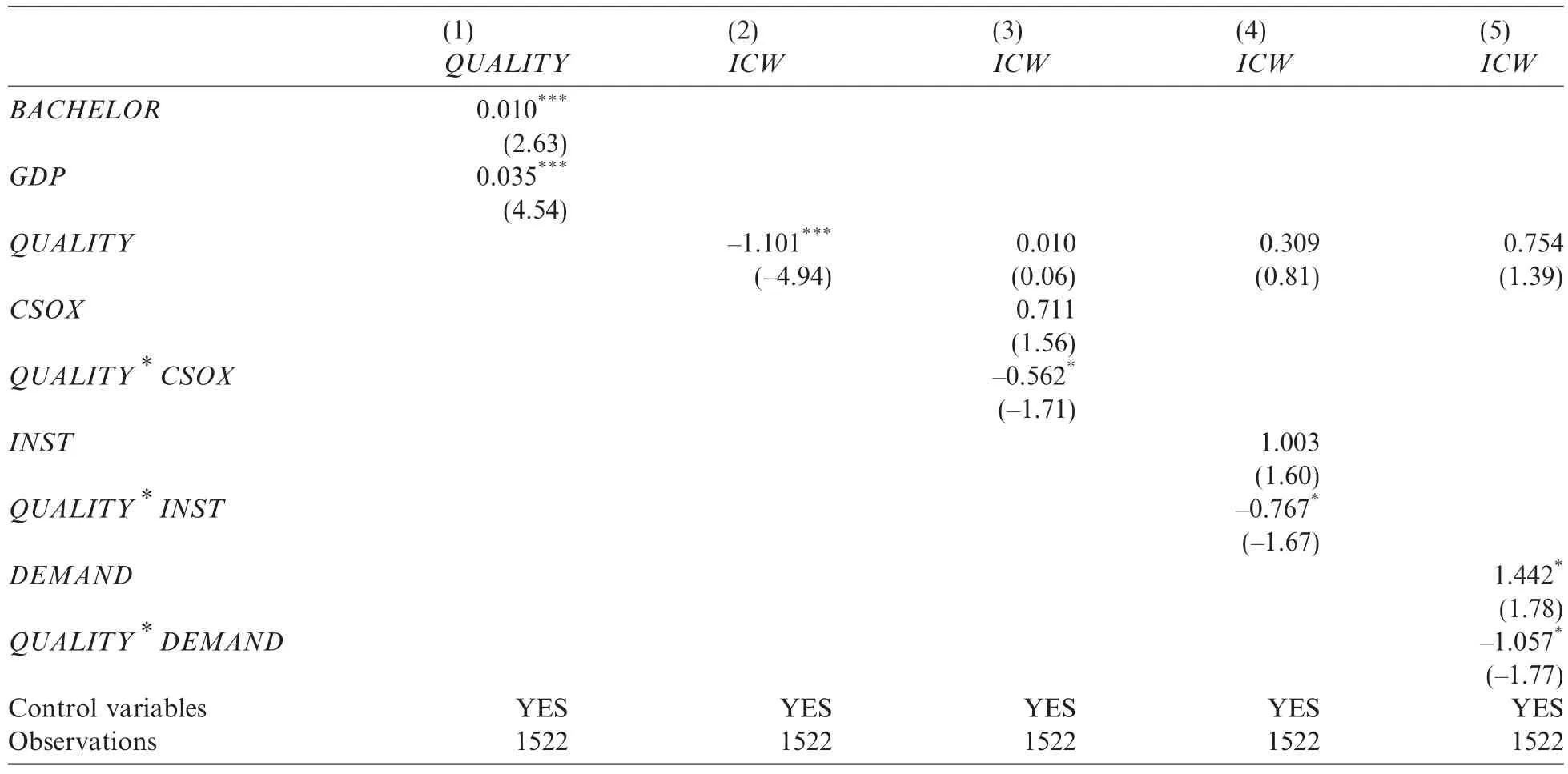
Table 8 Endogeneity test:2SLS regressions.
Table 8 presents the 2SLS regression results.For the sake of brevity,we only report the results of the main variables.As shown in column(1),consistent with our expectations,the coefficients ofBACHELORandGDPare positive and significant at the 0.01 level in the first stage regression.Furthermore,BACHELORandGDPalso pass the weak instrumental variable tests in the estimated 2SLS specifications.Columns(2)–(5)report the results from the second stage regressions.Consistent with our hypotheses,the coefficients ofQUALITY,QUALITY*CSOX,QUALITY*INSTandQUALITY*DEMANDare significantly negative.These findings furnish additional support for all of our hypotheses.
One might worry that the development level and human resource supply might vary greatly among cities in the same province,limiting the effectiveness of our instruments.Considering this,we only keep the firms that are located in the top two cities of each province and re-estimate the 2SLS regressions using the remaining 1033 observations.Untabulated results show that the coefficients ofQUALITY,QUALITY*CSOX,QUALITY*INSTandQUALITY*DEMANDare significantly negative,similar to the results reported in Table 8. Hence,we conclude that our findings are robust to an endogeneity bias.
6.3.Influence of chairman turnover
In Table 6,we assume that within a firm,the chairman’s attitude toward internal control remains unchanged throughout the 2011 to 2013 period.However,if the chairman resigned during this period,the succeeding chairman might have a different attitude to internal control and therefore change the tone at the top.Hence,to alleviate the influence of chairman turnover,we only keep the observations for firms without chairman turnover and re-estimate the regressions in Table 6.The new results are presented in Table 9.For the sake of brevity,we only report the results of the main variables.We find that the coefficients ofNUM*DEMAND,CORPEXP*DEMANDandQUALITY*DEMANDare significantly negative,which provides additional support for H4.Hence,we conclude that our findings are robust to the influence of chairman turnover.

Table 9 Robustness test:Excluding the effect of chairman turnover.
7.Conclusions
Our study examines the relationship between ICE quality and internal control quality,and the effect of monitoring on this relationship.Based on the input-process-output theory and agency theory,we argue that high quality ICEs increase the human capital investments in the design and implementation of internal control process,thus increasing internal control quality.Furthermore,effective monitoring can alleviate the agency problem between top managers and employees and further improve the positive effect of ICE quality on internal control quality.
Using special survey data from Chinese listed firms,we find that ICE quality has a significant positive influence on internal control quality,and this positive effect is more pronounced for firms in a strict monitoring environment.In particular,we find that the positive effect is more significant when firms implement CSOX, have higher institutional ownership,or attach great importance to internal control.Our results are robust to the misreporting problem of internal control weaknesses,endogeneity bias and chairman turnover.
Our research not only complements the literature on internal control and employee agency problem in theory,but also has important implications for practical corporate decisions on ICE allocation and monitoring. A fruitful extension of our research would be to investigate the paths and mechanisms through which ICEs influence internal control quality.Such analyses would help to develop a clearer picture of the functions of ICEs.
Acknowledgments
We thank anonymous reviewers,Bingxuan Lin,Bin Ke and Shunlin Song for their helpful comments.We appreciate the financial support from the National Natural Science Foundation of China(Nos.71332004, 71272198),Accounting Master Training Project of the Ministry of Finance(MOF No.15,2016),the Fundamental Research Funds for the Central Universities(No.16wkjc01)and Big Research Team Training Project of Sun Yat-sen University.
Alchian,A.A.,Demsetz,H.,1972.Production,information costs,and economic organization.Am.Econ.Rev.62(5),777–795.
Ashbaugh-Skaife,H.,Collins,D.W.,Kinney Jr.,W.R.,2007.The discovery and reporting of internal control deficiencies prior to SOX-mandated audits.J.Account.Econ.44(1–2),166–192.
Bae,K.,Kang,J.,Wang,J.,2011.Employee treatment and firm leverage:a test of the stakeholder theory of capital structure.J.Financ. Econ.100,130–153.
Balsam,S.,Jiang,W.,Lu,B.,2014.Equity incentives and internal control weaknesses.Contemp.Account.Res.31(1),178–201.
Bova,F.,Dou,Y.,Hope,O.,2015a.Employee ownership and firm disclosure.Contemp.Account.Res.32(2),639–673.
Bova,F.,Kolev,K.,Thomas,J.K.,Zhang,X.F.,2015b.Non-executive employee ownership and corporate risk.Account.Rev.90(1), 115–145.
Chang,X.,Fu,K.,Low,A.,Zhang,W.,2015.Non-executive employee stock options and corporate innovation.J.Financ.Econ.115(1), 168–188.
Chen,D.,Fan,C.,Shen,Y.,2015.Top management and employees:the comparison and interaction of incentive effectiveness.Manage. World 5,160–171(in Chinese).
Committee of sponsoring organizations of the Treadway commission,2013.Internal Control–Integrated Framework.The American Institute of Certified Public Accountants,New York.
Doyle,J.T.,Ge,W.,McVay,S.,2007.Determinants of weaknesses in internal control over financial reporting.J.Account.Econ.44(1–2), 193–223.
Edmans,A.,2011.Does the stock market fully value intangibles?Employee satisfaction and equity prices.J.Financ.Econ.101,621–640.
Ge,W.,McVay,S.,2005.The disclosure of material weaknesses in internal control after the Sarbanes-Oxley Act.Account.Horizons 19 (3),137–158.
Gladstein,D.L.,1984.Groups in context:a model of task group effectiveness.Adm.Sci.Quart.29(4),499–517.
Gong,G.,Ke,B.,Yu,Y.,2013.Home country investor protection,ownership structure and cross-listed firms’compliance with SOX-mandated internal control deficiency disclosures.Contemp.Account.Res.30(4),1490–1523.
Guo,J.,Huang,P.,Zhang,Y.,Zhou,N.,2016.The effect of employee treatment policies on internal control weaknesses and financial restatements.Account.Rev.91(4),1167–1194.
Hoitash,U.,Hoitash,R.,Bedard,J.C.,2009.Corporate governance and internal control over financial reporting:a comparison of regulatory regimes.Account.Rev.84(3),839–867.
Holmstrom,B.,1979.Moral hazard and observability.Bell J.Econ.10(1),74–91.
Holmstrom,B.,Milgrom,P.,1994.The firm as an incentive system.Am.Econ.Rev.84,972–991.
Huang,J.,Li,Z.,2014.Government intervention,employment and over-investment.J.Financ.Res.8,118–130(in Chinese).
Jensen,M.C.,Meckling,W.H.,1976.Theory of the firm:managerial behavior,agency costs and ownership structure.J.Financ.Econ.3 (4),305–360.
Kim,E.H.,Ouimet,P.,2014.Broad-based employee stock ownership:motives and outcomes.J.Financ.69(3),1273–1319.
Krishnan,J.,2005.Audit committee quality and internal control:an empirical analysis.Account.Rev.80(2),649–675.
Li,C.,Sun,L.,Ettredge,M.,2010.Financial executive qualifications,financial executive turnover,and adverse SOX 404 opinions.J. Account.Econ.50(1),93–110.
Lin,B.,Rao,J.,2009.Why do listed companies disclose the auditor’s internal control reports voluntarily?An empirical study based on signaling theory in China.Account.Res.2(45–52),93(in Chinese).
Lin,S.,Pizzini,M.,Vargus,M.,Bardhan,I.R.,2011.The role of the internal audit function in the disclosure of material weaknesses. Account.Rev.86(1),287–323.
Masli,A.,Peters,G.F.,Richardson,V.J.,2010.Examining the potential benefits of internal control monitoring technology.Account.Rev. 85(3),1001–1034.
Naiker,V.,Sharma,D.S.,2009.Former audit partners on the audit committee and internal control deficiencies.Account.Rev.84(2),559–587.
Rajan,R.G.,Zingales,L.,1998.Power in a theory of the firm.Quart.J.Econ.113(2),387–432.
Rajan,R.G.,Zingales,L.,2000.The Governance of the New Enterprise.Working Paper.The National Bureau of Economic Research.
Rice,S.C.,Weber,D.P.,2012.How effective is internal control reporting under SOX 404?Determinants of the(non-)disclosure of existing material weaknesses.J.Account.Res.50(3),811–843.
Shleifer,A.,Vishny,R.W.,1986.Large shareholders and corporate control.J.Polit.Econ.94,461–478.
Tian,G.,Qi,B.,Li,L.,2010.Determinants of the discovery and reporting of internal control deficiencies over financial reporting.Nankai Bus.Rev.4,134–141(in Chinese).
Weber,M.,1947.The Theory of Economic and Social Organization.Oxford University Press,Oxford.
Wu,Y.,Liu,X.,2009.Human capital and R&D activity:evidence from Chinese private enterprises.China Econ.Quart.4,1567–1590(in Chinese).
Zenger,T.R.,Lawrence,B.S.,1989.Organizational demography:the differential effects of age and tenure distributions on technical communication.Acad.Manage.J.32(2),353–376.
*Corresponding author at:Sun Yat-sen Business School,Sun Yat-sen University,China.
E-mail address:liuchli@mail2.sysu.edu.cn(C.Liu).
http://dx.doi.org/10.1016/j.cjar.2016.12.002
1755-3091/?2016 Sun Yat-sen University.Production and hosting by Elsevier B.V.
This is an open access article under the CC BY-NC-ND license(http://creativecommons.org/licenses/by-nc-nd/4.0/).
Internal control
Monitoring
Human capital
 China Journal of Accounting Research2017年1期
- China Journal of Accounting Research的其它文章
- Are academic independent directors punished more severely when they engage in violations?☆
- Economic policy uncertainty,credit risks and banks’lending decisions:Evidence from Chinese commercial banks
- Regulatory pressure and income smoothing by banks in response to anticipated changes to the Basel II Accord☆
- Accounting research in banking–A review