
Analysis of the Concept and Connotation of the New Economy and Reconstruction of Its Development Path: A Study Based on Chengdu’s Practices
2022-03-17 08:25:10LiMingxing
Contemporary Social Sciences 2022年1期
Li Mingxing
Sichuan University
Abstract: In order to promote the transformation and development of China’s economy and cope with the realistic challenges posed by the global economic recession and slowing domestic economic growth, the Fourth Session of the 12th National People’s Congress adopted a strategic resolution on developing the “new economy” and fostering new drivers of growth. Chengdu, capital of Sichuan province, is one of the cities in China which firstly begin to carry out the layout of the new economy development. While achieving results, it also faces many troubles due to its insufficient cognition of the connotation, definition, and path of the “new economy.” The paper is based on a theoretical study in combination with the new economic development of Chengdu’s five new paths, to analyze the concept and connotation of the “new economy.” It also analyzes from the perspective of higher dimensional reconstruction and new strategic path of economic development, in order to add some insights to the theorectical study and to promote better strategic value of the new economy.
Keywords: new economy, Chengdu, perplex, reconstruction, strategic path
Introduction
Studies show that the term “new economy” originated from the United States and refers to the economic system led by the high-tech industry driven by the information technology revolution represented by IT in the 1990s (Li, 2016). At that time, the public cognition of the new economy was mainly concentrated in the tertiary industry, which was dominated by the application of information technology. With the development of science and technology, especially the rise of artificial intelligence (AI) and the Internet of Things (IoT) technology, the new economy is nowadays no longer limited to the tertiary sector. It also involves the primary and secondary industries, including new applications, new models, and new ideas that are based on technological transformations. The most typical one is the sharing economy (Jiang, 2018). Chengdu started developing the new economy in 2017, focusing on five new economic forms, i.e., smart economy, digital economy, sharing economy, flux economy, and green economy. Many innovative practices have been carried out. For example, seven application scenes, such as smart cities, entrepreneurship and innovation platforms, and modern supply chains were planned and fostered (Lin, 2020); a new economic service organization system of “government + think tank + entrepreneur organization” was perfected (Min et al., 2020); and a list of urban opportunities for Chengdu was developed (Zhou, 2019). According to available data, Chengdu ranked fourth in the aggregate index of the new economy in China in 2017. By the second half of 2020, it ranked new first-tier cities in China. It achieved a breakthrough in unicorn companies. The number of the new economy companies increased to 360,000, and the venture capital received increased to RMB52 billion. The revenue of the new economy exceeded RMB400 billion. Chengdu ranked third nationwide in terms of the new economic vitality index and the scale of new occupations. The rapid rise of the new economy has become a new driving force for high-quality economic development. However, disputes and blind spots exist in the current understanding of the concept and connotations of the new economy, leading to bias in its development path. Therefore, the article analyzed the concepts and connotations of the new economy for clarification.
Concepts of the New Economy and Its Origin
Since the birth of the concept in the 1990s, “new economy” has been endowed with various new connotations, and the cognition of the theoretical circle is also varied. Some believe that the new economy is a technological concept, such as Zhang Ruimin, president of Haier Group, and Wang Mengkui, an economist. They define the new economy as an economy with sustainable development driven by new technology and based on digital knowledge and network technology, with innovation as the core (Zhang, 2000; Li, 2001). Or it can be understood as a high-tech industrial chain formed by the mutual infiltration of mathematical, biological and physical technologies generated by information technology as the main force (Xie, 2018). In this regard, scholars predict that information technology will be the main driving force of the new economy in the next 15-20 years (Li, 2017). Some believe that the new economy is a new economic form, which is the concentrated embodiment of the knowledge-based, innovative, green, sharing, open, digital and personalized economic types (Ren et al., 2020). It is a new round of economic activities and economic forms, typical of which is the “digital economy” (Chen et al., 2017). Moreover, it can create effective demand with its own supply (Shu, 2019). Of course, some scholars have integrated the concepts of technology and form, and believe that the new economy is an economic activity or business mode with high human capital input, high technology content and relatively innovation (Cheng et al., 2017), which includes new technology, new industries, a new business mode and a new mode.
It is undeniable that various understandings of the concept of the new economy in the theoretical community have theoretical foundations and practical significance. However, most of them are defined based on certain individual characteristics or special performances from a predetermined industry or professional perspective. Relatively speaking, the third group’s connotations are instructive, but they are not formed from a higher strategic dimension. Therefore, it is still challenging to form a more general and broad sense of understanding. Overall, it is difficult to form an agreedupon concept for the new economy.
An Overview of the New Economy Development at Home and Abroad
Overview of Foreign Development
Data show that Germany proposed Industry 3.0 in the 1960s, which required the integration of information technologies, such as automation, computers, and robotics into manufacturing; Germany attempted to stimulate industrial transformations by promoting the development of information and communication technologies. The US put forward the “National Information Infrastructure Construction Plan” in 1993, trying to build a national computerized information system (Long et al., 2020). Japan also put forward the strategy of “Nation Based on the Creation of Science and Technology” in 1994 and actively developed the world’s leading high-tech (Ji, 2005). With the development of the new economy in various countries, these industrial powers witnessed a sharp decline in the proportion of manufacturing industries and a rapid increase in the proportion of service industries in their GDP, thus giving impetus to the new stage of breakthrough developments in their national economies. At the beginning of the 21st century, countries like the US, which proposed and pioneered the concept of the new economy and implemented new economic development strategies, all achieved economic transformations and upgrading, and ranked among the major economies in the world.
Overview of Domestic Development
In February 2016, Chinese Premier Li Keqiang explicitly mentioned the new economy for the first time and included it in the government work report as the government’s policy agenda. In October 2020, the Fifth Plenary Session of the 19th Central Committee of the Communist Party of China (CPC) further proposed the long-term goal of basically realizing new industrialization, IT application, urbanization, and agricultural modernization and building a modern economic system by 2035, which indicates the direction for China’s new economic development. In addition, the CPC Central Committee and the State Council clearly demanded the acceleration of the development of “three new” economies with new industries, new business forms, and new business models as the core content. The new economy has also entered the national statistical system. By 2019, China’s “three new” economies accounted for 16.3 percent of GDP, with a growth of 9.3 percent. The average annual growth rate was two percentage points higher than the current GDP growth rate.①The new economy has formed a new driver for economic development and significantly stimulated the national economy.
The Main Problems That the New Economy Development Faces at Present- Take Chengdu as an Example
At present, while the new economy is developing vigorously, it also faces many practical problems, among which some are technical and some are theoretical. But in fact, the core problem is that the connotation of the new economy is not accurate enough to make the practical logic of developing the new economy been properly understood.
The Connotation of the “New Economy” Is Not Comprehensive
Since the development of the new economy was advocated in China, all regions and cities have rushed to accomplish the major parts of the new economy, among which the most obvious feature is the focus on high-end technological industries industries. Practices of attracting and fostering enterprises are targeted at the development and application of high technology and are vigorously promoted. Such practices include attracting leading companies, cultivating gazelle companies, and fostering unicorn companies, which are blooming. Behind this seemingly prosperous boom, however, no one has ever seriously considered the fundamental question of what the new economy actually is. They basically comply with a tacit game standard that only new technologies and applications, such as the Internet, big data, and cloud computing can be called a new economy. Based on this, many new technology companies focusing on high-tech applications are rapidly gestating. However, some traditional companies, sectors, and industries, such as agriculture-related fields do not have a strong sense of participation. In this regard, some have also raised questions about whether the new economy refers to the basic transformation of the traditional economy or the cultivation of a new segment of the old economy. Although they have broadened their horizons, they still portray the new economy from a concrete and static perspective. Therefore, it is difficult to reach a consensus.
An Inaccurate Grasp of the Path of Developing the New Economy
In the process of developing the new economy, many cities have constructed a logical path according to their own realities. For example, Shanghai takes the path of using new infrastructure to support the new economy, new connections to enable new consumption, and new services to create a new ecology;①Full execution of online new economy in Shanghai. xinhuanet.com/Xinmin Evening News; http://www.sh.xinhuanet.com/2020-06/09/c_139126051.htmHangzhou takes the path of digital industrialization, industrial digitization, and urban digitization.②Embracing the new economy and releasing new vitality in Hangzhou, Zhejiang. People’s Daily Online; http://www.chinaxiaokang.com/chengshi/2020/1207/1091882.htmlEarly in 2017, Chengdu put forward five new development paths, with new technologies, new organizations, new industries, new business forms, and new models as the core content. Three years later, the city revolved around new subjects, new tracks, new carriers, new scenes, and a new ecology as the core contents to carry out path reshaping and dimension upgrading. The micro dimensions have been upgraded from the technology and organization to the subject and carrier; the meso dimension has been upgraded from the industry and business form to the track and scene; the macro dimension has been upgraded from model to ecology. Although the new path is more in line with the future orientation of the new economy, it still has immature aspects. First, the connotations and orientations of the five new paths are not sufficiently compatible. For example, the understanding of new tracks is limited to industries, emphasizing the commitment in various industrial subdivisions to developing new tracks. The definition of new subjects is narrow, without realizing that enterprises are only one form of the subject. It focuses only on leading enterprises and pays little attention to the interactive behaviors of multiple subjects in the markets. The understanding of new scenes is representational. It only focuses on the construction of the scenery represented by niche consumption, but does not consider the construction of sites. As a result, the scenery is separated from the site, or there is scenery but no site, making it difficult to achieve the Bilbao effect.③The Bilbao effect is also known as the miracle of the museum, of which the museum community is proud. It refers to a phenomenon whereby Bilbao became prosperous due to the agglomeration of a large number of architectural masterpieces. This example of changing the destiny of a city is described by the New York Times as a miracle, which is known as the Bilbao Effect.The most typical example is the large number of government-supported Internet-famous sites in Chengdu and its surrounding areas. Most of them are temporary consumption spaces and can hardly have long-term and sustainable development. Second, the internal logic of the five new paths is not sufficiently accurate. In the beginning, it was believed that the five aspects in the five new paths would show a parallel relationship, i.e., the five aspects would depend on each other and develop in parallel (Fig. 1). Later, it was argued that they should show a progressive relationship, i.e., they should logically evolve according to their content (Fig. 2). In fact, neither the parallel nor progressive relationship can accurately reveal the internal relationships between each part. The parallel relationship cannot clearly divide the boundaries of each parallel part, and the progressive relationship can hardly clarify the logical connection of each link. Neither of them can achieve a high degree of adaptation between the concrete concept and the embedded logic. Therefore, the explanatory power of the five new paths is greatly reduced.
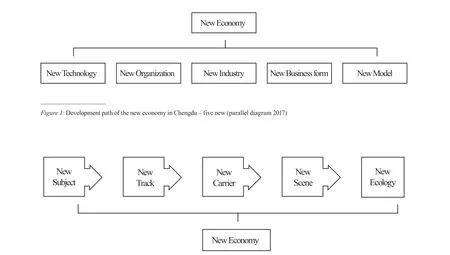
Figure 2: Development path of the new economy in Chengdu - five new (progressive diagram 2021)
Re-Analysis of the Concept and Connotation of the New Economy
It is not difficult to see that the premise of finding a realistic and rational path for the development of the new economy is to accurately define the concept of the “new economy” and its connotation.
A New Understanding of the Concept of the “New Economy”
The concept of the new economy has undergone reciprocal corrections a nd continuous supplements from technologies to forms. Technologies, factors, and models have continued to iterate. From this logic, defining the new economy in any single dimension from any time node can hardly ensure the lasting stability of its conceptual expression and connotation. Based on this reality, this article defines the new economy as a comparative state of economic development from the abstractionism of the historical development trajectory.
The comparative state has three meanings. The first one is a dynamic connotation. That is, the comparative state means continuous change. It is not defined based on a certain stage, a certain type, or a certain characteristic, but refers to a dynamic development phenomenon. The second one is a comparative connotation. That is, the comparative state is a relative rather than absolute concept, which means that it is never judged by chronological order. Any model or object with comparative advantages can be classified into the scope of the new economy. The third one is a boundary connotation. The orientation of the comparative state is not limited to the target image or industry differentiation, nor is it limited to the form rhythm and model selection. The technologies, models, concepts, etc., that can better meet the needs of current and future economic and social developments are all new economies. New economies include not only emerging industries and business forms, such as the Internet+, the Internet of Things, cloud computing, and e-commerce in the tertiary industries, but also intelligent manufacturing and large-scale customized production in the manufacturing industries. Family farms that are conducive to the promotion of moderate-scale operation and the joint-stock cooperative system in the primary industry, as well as the integrated development of rural primary, secondary, and tertiary industries, are also regarded as new economies.①Li Keqiang: To develop the new economy is to cultivate new drivers and promote the economic transformation of China. http://www.gov.cn/guowuyuan/2016-03/16/content_5054244.htm
A New Understanding of the Connotation of the “New Economy”
It is of realistic value that Chengdu condenses the connotation of the new economy into “five new,” but it is obviously lacking scientific integration, including historical track, image representation, content direction and law expression in terms of its content. Here, the author makes the following clarification.
The new track is based on the concept of factor selection.
The term “track” has been widely used, starting in 2015. At that time, traditional industries, in the context of the Internet, were divided into many new sub-industries, such as Internet+ medical and Internet+ autos. Investors considered these tracks to be market gimmicks. However, the new tracks from the government’s perspective could explain the entire new economic form. From the perspective of orientation, it is a specific required direction based on market participation and public management. In addition, it is abstracted from higher-dimensional objects of sectors and industries. It is manifested as an essential element of serving the public and public participation and contains the process of fair competition and rule-based elimination. Therefore, from the perspective of respecting needs and willingness, the economic aspects that meet the characteristics of tracks are the factors. This is because factors are not only homogeneous in economic participation, but also competitive, which is in line with the focus and purpose of the government’s public management. In addition to traditional factors (i.e., land, labor, capital, and technology), the new economy regards data as a new element. Therefore, for the new economy, new tracks are the new factors represented by data. The development of new tracks refers to the innovative development and use of data-centered new factors.
The new scene is based on the concept of aggregation of elements.
The term “scene” originally referred to scenes in dramas and movies. It was then gradually applied to various disciplines, such as sociology and communications. Its interpretation has also changed from a purely spatial bias to the sum of the relationships between people and the surrounding scenery. Its core consists of hard factors, such as sites and scenery, as well as soft factors, such as related spaces and atmospheres (Tan et al., 2018). From this perspective, a scene is essentially an interactive combination of different sites and scenery. In the economic field, a scene is used to describe a scenario or form in which various economic activities interact with participants. New scenes refer to more innovations in more forms, content, and relationships in general economic scenarios. In this regard, the article believes that for the new economy, a new scene is the superposition of the factors of economic activities, such as objects, space, and relations, and their interactions. The supply of new scenes is a process of aggregating the people, things, and relations in the market to pursue changes.
The new subject is based on the concept of process participation.
In philosophy, the term “subject” refers to a person who can understand and manipulate an object. In the economic field, the definition of the subject is usually generalized to refer to an organization or individual that undertakes a certain role or carries out corresponding activities. It contains three dimensions of connotations. From the dimension of attribute characteristics, subjects refer to natural persons and legal persons. From the dimension of economic boundaries, subjects are divided into market entities and non-market entities. From the dimension of relationship stickiness, subjects refer to direct subjects and indirect subjects. Based on these connotations, new subjects should be multiple parties involved in specific supply and demand sectors, including the supply side, demand side, and intermediate party. Therefore, for the new economy, a new subject is an economic participant with stronger adaptability and innovation abilities after being transformed by the new environment. To cultivate new subjects is to provide necessary factors and service support to guide the growth and development of new subjects.
The new carrier is based on the concept of functional services.
In science and technology, carrier specifically refers to certain things that can transmit energy or carry other things. It also generally refers to all things that can carry other things and the intermediary things used in the process of state changes. Wu et al. (2001) argued that a carrier of economic development is a platform that can stably carry, transmit, and catalyze economic growth for a long time and play a core supporting role. It includes factor carriers, industrial carriers, geographical carriers, socio-economic relation carriers, and ownership carriers. Inspired by this, the article believes that the understanding and definition of a new carrier should focus on three aspects: a) the carrying space for the existence and activities of subjects; b) the necessary supporting services required for the activities of subjects; c) the co-product of self-formation and artificial guides. Therefore, for the new economy, a new carrier is a space that serves the growth and development of economic subjects. The construction of a new carrier refers to opening a space for the activity of a new subject and improving the service functions of the space.
The new ecology is based on the concept of linkage and interaction.
Ecology originally referred to the state of living and development of organisms in a certain natural environment. It also refers to various physiological characteristics and living habits of organisms. Later, the field of social science research introduced this concept and derived concepts, such as economic ecosystems and industrial ecosystems. According to the literature, an ecosystem embodies a new industrial development model and a new industrial development layout (Yuan, 2004). Economic ecology regards the human, political, cultural, institutional, and natural ecological environment resources as internal components of the economy (Wang, 2005). In other words, economic ecology is a concept integrating all factors and subjects in economic activities, emphasizing universal connections and activity rules. Therefore, for the new economy, the new ecology is a systematic manifestation of the material base, object-subject, and rule relationships in social activities based on all economic factors. To create new ecology is to build a more standardized, efficient, and orderly factor and rule system.
Reorganization: Logic in the Development Path of the New Economy
The core of reconstructing the development path of the new economy lies in looking at and clarifying the starting point, process, and goals of the development of the new economy from the perspectives of both the government and the markets. That is, efforts will be made to fully coordinate the decisive role of the markets in the allocation of resources and give better play to the government’s regulatory and management roles. Through the analysis of Chengdu’s five new paths, it is easy to find that only the concepts and connotations of the new track and the new ecology involve a government perspective, while the rest focus more on market perspectives or market behaviors. On this basis, it is possible to clearly and scientifically define the logical path for the development of the new economy. That is, the government’s track construction and macro-control of data-centered new factors are regarded as the starting point. Efforts should then be made to guide the market to compete and develop around the data factors, and further promote the survival of the fittest among subjects, the practice of model innovation, and the evolution of functional clusters. All these are systematically constrained by institutional rules. Finally, all these efforts are combined to build a benign and sustainable new economic ecosystem (Fig. 3). In short, the new track is the starting point, specifically indicating data-centered factors; the new ecology is the goal, specifically indicating economic laws and development patterns; new subjects, new carriers, and new scenes are all processes, which specifically indicate the presence of the various contents of market economic activities.

Figure 3: Development path of the new economy (Compound)
The rationality of the development path of the new economy in compound logic is embodied in three aspects. First, it is reasonable to use data factors as the starting point. Factors are the most basic conditions of social and economic activities. Subjects, carriers, scenes, or others all use and rely on factors. Therefore, the attribute characteristics of the factors are highly consistent with the concrete representations of the tracks. They all have basic, public, and open foundations. New tracks also mean the innovative choices that are made based on the factors of traditional tracks. In addition, data factors have become the consensus of economic and social development. Han Feng emphasizes in his bookBlockchain and the Wealth of Nations—Future Wealth Based on Global Credit Algorithm Consensusthat the consensus on wealth based on personal data and accounts is the future trend, and wealth is credit resources. Therefore, whether it is market competition or regional development competition, data monetization will be the essence in the future. In addition, in April 2020, the government issuedthe Opinions of the CPC Central Committee and the State Council on Building a More Complete Factor Market Allocation System and Mechanism, which officially listed data as one of the five major production factors. These theoretical foundations and policy orientations are highly consistent in supporting the rationality of data factors as a starting point. Second, it is reasonable to take ecology creation as the goal. Economic ecology is essentially a macro summary of a virtuous circular economy system, and it is the goal of all economic activities and economic research. Political ecology and economic ecology comprise all economic and social relations. This further proves that a new ecology is undoubtedly the direction and goal of the development of the new economy. Third, it is reasonable to take building new carriers, cultivating new subjects, and supplying new scenes as the process. As mentioned above, new subjects, new carriers, and new scenes are essentially the contents related to market perspectives or market activities. For example, the construction of new carriers represented by industrial functional zones, to a large extent, relies on the cluster development of traditional primary market subjects. Governmental support has promoted their professionalization, standardization, and systemization. The introduction and fostering of new subjects, mainly representative enterprises, is based on the rational study and selection of market development by investment operators. The supply of new scenes, which are innovated and iterated based on various niche needs, is also a result of the interactions of multiple parties involved in consumer relationships. Therefore, new subjects, new carriers, and new scenes are equivalently regarded as the process and results of the market movement. It should be noted that these are only a part of the process. Other contents may be added as required by future developments.
Comments and Suggestions on Promoting Sustainable Development of the New Economy
Setting foot in the new era, implementing new concepts, and building a new pattern are important components of the plan for promoting high-quality economic development. However, a targeted and overall consideration is yet to be taken. Based on the above analysis and investigation, this article puts forward some opinions and recommendations based on the five new paths to explore the valuable experience that can be implemented, promoted, and replicated.
Accelerating the Building of a Data-Centered New Ecology Development Path
At present, many cities in China, represented by Hangzhou, have implemented the strategic blueprint of government-oriented big data factors and applications. Chengdu should give serious attention to this and show investors’ insights to seize the trend of data factors as early as possible. First, Chengdu should develop a big data resource platform and explore various methods, such as independent development or cross-domain cooperation to build a public big data service carrier for future industrial development and industry iterations. Second, the reserve of talents for big data should be deployed to speed up the recruitment of leading talents in the big data field. It is more important to rely on universities and research institutes to implement big data talent cultivation projects to pool potential talents. Third, it is necessary to deploy the hardware foundation for data applications. Specifically, facilities and equipment should be set up and planned for big data application scenarios, such as artificial intelligence, unmanned driving, and digital finance to be well prepared for application competition.
Cultivating Vigorously a New Economy Underpinned by Consumption
In the context of the new economy, the traditional market consumption logic of demand-driven supply can no longer apply to all situations. Innovative supply to stimulate potential demand has gradually become the unspoken rule of the market. Therefore, the horizon for the cultivation of new subjects must be broadened. It is appropriate not only to pay attention to the production side, but also to attach importance to the consumer side and intermediate links. This will drive a virtuous market cycle by cultivating the entire industry chain and creating a new economy-focused business environment. As a city with high consumption vitality, Chengdu should make more efforts to cultivate all the subjects of consumption. First, new subjects of consumption supply should be cultivated. Especially, joint efforts should be made to solve the pain points of the supply chain, e.g., to improve logistics, warehousing, venues, and facilities, to create a production-end environment with convenient supply sources. Second, new subjects for consumer demand should be cultivated. Policy tools should be leveraged as much as possible to generate consumption dividends for consumer groups, raise salaries, lower prices, and reduce the intermediate costs of consumption. The city should also respect diversified and innovative consumption patterns and guide consumers to use more funds for daily consumption. Third, new subjects of consumer assistance should be cultivated. That is, vigorous support should be provided for the development of various industry associations, alliances, and market think tanks to give full play to their decision-making support roles in enhancing market supplies and accelerating the supply-demand cycle.
Optimizing and Improving the Rule-Based New Economic Ecosystem
Compared with the traditional economy, the new economy has more breakthroughs and is more uncontrollable. Chengdu must always remain vigilant and seek early regulation and ecology development for the new economy. The first focus should be on property rights management. The city should recognize and value the importance of digital property rights, form and strengthen the awareness of digital property rights and centralized management. The city also needs to actively explore the use of blockchain technologies to accelerate the exploration of digital rights confirmation and to improve digital capabilities to firmly hold the lifeblood of financial capital. The second attention should be paid to institutional constraints. That is, the city should speed up the formulation of rules and regulations for privacy protection and authorized use of information to stifle information crime in the cradle. The third focus should be on mechanism innovations. The city should actively promote simultaneous digital transformations of the management systems. In this manner, Chengdu will continue to innovate in and use more digital tools to strengthen and enhance its ability to create a new ecology for the new economy.
 Contemporary Social Sciences2022年1期
- Contemporary Social Sciences的其它文章
- A Study of the Rain Classroom-Based Teaching Mode of College English for Art or Physical Education Majors
- Research on the Collaborative Innovation Model in Regional Social Governance
- An Empirical Study on the Relationship Between the Scale of International Students from ASEAN and China’s Outward Foreign Direct Investment
- A Comparative Study of Development and Reform of Urban-Rural Integration in Chengdu and Chongqing Based on System Theory
- A Brief Introduction to Sichuan Academy of Social Sciences
- Requirements for Submissions